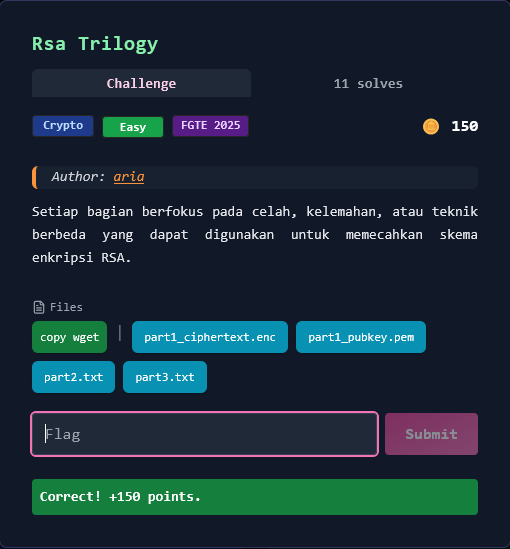
Write Up – RSA Trilogy
Write-up bisa dibaca langsung di halaman ini atau diunduh sebagai file PDF.
Write Up – RSA Trilogy
Write Up – RSA Trilogy
Challenge Overview
Category: Crypto
Difficulty: Easy
Author: aria
Challenge ini terdiri dari 3 bagian RSA yang masing-masing mengeksploitasi celah atau kelemahan berbeda dalam implementasi RSA. Setiap bagian memberikan satu potongan flag yang harus digabungkan untuk mendapatkan flag lengkap.
Format flag:
FGTE{...}
Files Given
1. Part 1 Files
part1_pubkey.pem- RSA public key (PEM format)part1_ciphertext.enc- Base64-encoded ciphertext
2. Part 2 File
part2.txt- Containsn,e, andciphertextvalues
3. Part 3 File
part3.txt- Containsn,e,x(sum of primes), andciphertextvalues
Part 1: Small Exponent Attack (e = 3)
Key Insight
Low Public Exponent without Padding
e = 3
Ketika eksponen publik sangat kecil (e=3) dan plaintext kecil, maka m^3 < n, sehingga tidak terjadi modulo operation.
Attack:
c = m^3 (no modulo)
m = ∛c
Solution
import base64
from Crypto.PublicKey import RSA
from Crypto.Util.number import bytes_to_long, long_to_bytes

def iroot_k(n, k):
    """Calculate integer k-th root"""
    lo, hi = 0, 1
    while hi**k <= n:
        hi *= 2
    while lo + 1 < hi:
        mid = (lo + hi) // 2
        if mid**k <= n:
            lo = mid
        else:
            hi = mid
    return lo

# Load public key
pub_pem = open("part1_pubkey.pem", "rb").read()
rsa = RSA.import_key(pub_pem)
e1, n1 = rsa.e, rsa.n

# Load and decode ciphertext
ct1_b64 = open("part1_ciphertext.enc", "r").read().strip()
c1 = bytes_to_long(base64.b64decode(ct1_b64 + "==="))

# Small exponent attack: m = ∛c
m1 = iroot_k(c1, 3)
part1 = long_to_bytes(m1).decode()

print(f"Part 1: {part1}")
Result: FGTE{small_e_works_
Part 2: Wiener's Attack (Large e, Small d)
Key Insight
Wiener's Attack on RSA with Small Private Exponent
Dari part2.txt:
n = 104150539323944854218222518232816171826386239923685519274534329680325309132683974594098331104258403147344177189768073033564919038098442267302014694387412013822707091084490543236331842059391521420457366362728247711745105766612827412454300663568582320270027088610499841553840112523546156538174899290062988597593
e = 78740579270309350500158260397098709642129833310142201531554618974616246780757900680733070610557494359287280468205012618493909046694049056934377160129901445553460919676068672752533789927521693126839943987273791616604585961061211346527756846169228011392373290381588435250066915289098198037239703070080127336841
Nilai e sangat besar (hampir sebesar n), mengindikasikan d sangat kecil. Ini vulnerable terhadap Wiener's Attack.
Attack Method:
- Compute continued fraction expansion of
e/n - For each convergent
k/d, test if it's valid private key - Check if
(e*d - 1) % k == 0danφ = (e*d - 1)/kvalid
Solution
import math
from Crypto.Util.number import inverse

def cont_frac(a, b):
    """Continued fraction expansion"""
    cf = []
    while b:
        q = a // b
        cf.append(q)
        a, b = b, a - q*b
    return cf

def convergents(cf):
    """Calculate convergents from continued fraction"""
    out = []
    for i in range(len(cf)):
        num, den = 1, 0
        for a in reversed(cf[:i+1]):
            num, den = den + a*num, num
        out.append((num, den))
    return out

def wiener_attack(e, n):
    """Wiener's attack to recover d, p, q"""
    cf = cont_frac(e, n)
    for k, d in convergents(cf):
        if k == 0:
            continue
        if (e*d - 1) % k != 0:
            continue
        phi = (e*d - 1) // k
        s = n - phi + 1
        disc = s*s - 4*n
        if disc < 0:
            continue
        t = math.isqrt(disc)
        if t*t != disc:
            continue
        p = (s + t) // 2
        q = (s - t) // 2
        if p*q == n:
            return d, p, q
    return None

# Parse part2.txt
txt2 = open("part2.txt", "r").read()
n2 = int(txt2.split("n = ")[1].splitlines()[0].strip())
e2 = int(txt2.split("e = ")[1].splitlines()[0].strip())
c2 = int(txt2.split("ciphertext = ")[1].splitlines()[0].strip())

# Wiener's attack
d2, p2, q2 = wiener_attack(e2, n2)

# Decrypt
m2 = pow(c2, d2, n2)
part2 = long_to_bytes(m2).decode()

print(f"Part 2: {part2}")
Result: wiener_strikes_back_
Part 3: Known Sum of Primes (p + q)
Key Insight
Factoring n when p+q is Known
Dari part3.txt:
n = 0x6b26d86d654e1bb88dbd6da05866e97eebc1169dce56bd3c52c65c49851ffe3bc5ae114cc22fa491f6d6675ba1fdb7a846d199f5e9e68af6322ab7ead2c481aa160c15f9132e0ee07e84423d3e0fa108857198250bb37f032c9499b205beb0f42aee43b533dc79f53a7e27737dd7679d4d44f0beed6a15e78179449a0c655603
e = 65537
x = 0x14ddc18c5fe16ac1125fe2a7049c3c53f98d2c5ecf552013534ddbfc06a714fe094eb33226ad6273eeb9a30d9c01d752b4f7adae4e34c16532cd6b8e2d4e01bac
Di mana x = p + q.
Attack:
Jika kita tahu p + q dan p * q = n, kita bisa solve quadratic equation:
p + q = x
p * q = n

Dari persamaan kuadrat: t² - xt + n = 0
Diskriminan: Δ = x² - 4n
p = (x + √Δ) / 2
q = (x - √Δ) / 2
Solution
import math
from Crypto.Util.number import inverse, long_to_bytes

# Parse part3.txt
txt3 = open("part3.txt", "r").read()
n3 = int(txt3.split("n = ")[1].splitlines()[0].strip(), 16)
e3 = int(txt3.split("e = ")[1].splitlines()[0].strip())
x3 = int(txt3.split("x = ")[1].splitlines()[0].strip(), 16)  # p + q
c3 = int(txt3.split("ciphertext = ")[1].splitlines()[0].strip(), 16)

# Solve quadratic equation
disc = x3*x3 - 4*n3
t = math.isqrt(disc)

if t*t != disc:
    raise ValueError("Discriminant is not a perfect square!")

p3 = (x3 + t) // 2
q3 = (x3 - t) // 2

# Verify factorization
assert p3 * q3 == n3

# Calculate private key
phi3 = (p3 - 1) * (q3 - 1)
d3 = inverse(e3, phi3)

# Decrypt
m3 = pow(c3, d3, n3)
part3 = long_to_bytes(m3).decode()

print(f"Part 3: {part3}")
Result: sum_of_primes_indeed!}
Complete Solve Script
#!/usr/bin/env python3
import base64, math
from Crypto.PublicKey import RSA
from Crypto.Util.number import bytes_to_long, long_to_bytes, inverse

# ---------- Helpers ----------
def iroot_k(n, k):
    lo, hi = 0, 1
    while hi**k <= n:
        hi *= 2
    while lo + 1 < hi:
        mid = (lo + hi) // 2
        if mid**k <= n:
            lo = mid
        else:
            hi = mid
    return lo

def cont_frac(a, b):
    cf = []
    while b:
        q = a // b
        cf.append(q)
        a, b = b, a - q*b
    return cf

def convergents(cf):
    out = []
    for i in range(len(cf)):
        num, den = 1, 0
        for a in reversed(cf[:i+1]):
            num, den = den + a*num, num
        out.append((num, den))
    return out

def wiener_attack(e, n):
    cf = cont_frac(e, n)
    for k, d in convergents(cf):
        if k == 0:
            continue
        if (e*d - 1) % k != 0:
            continue
        phi = (e*d - 1) // k
        s = n - phi + 1
        disc = s*s - 4*n
        if disc < 0:
            continue
        t = math.isqrt(disc)
        if t*t != disc:
            continue
        p = (s + t)//2
        q = (s - t)//2
        if p*q == n:
            return d, p, q
    return None

# ---------- PART 1: Small Exponent Attack ----------
print("[*] Solving Part 1: Small Exponent Attack (e=3)")
pub_pem = open("part1_pubkey.pem", "rb").read()
rsa = RSA.import_key(pub_pem)
e1, n1 = rsa.e, rsa.n

ct1_b64 = open("part1_ciphertext.enc", "r").read().strip()
c1 = bytes_to_long(base64.b64decode(ct1_b64 + "==="))

m1 = iroot_k(c1, 3)
part1 = long_to_bytes(m1).decode(errors="replace")
print(f"[+] Part 1: {part1}")

# ---------- PART 2: Wiener's Attack ----------
print("\n[*] Solving Part 2: Wiener's Attack")
txt2 = open("part2.txt", "r").read()
n2 = int(txt2.split("n = ")[1].splitlines()[0].strip())
e2 = int(txt2.split("e = ")[1].splitlines()[0].strip())
c2 = int(txt2.split("ciphertext = ")[1].splitlines()[0].strip())

res = wiener_attack(e2, n2)
if not res:
    raise SystemExit("[-] Wiener attack failed!")

d2, p2, q2 = res
m2 = pow(c2, d2, n2)
part2 = long_to_bytes(m2).decode(errors="replace")
print(f"[+] Part 2: {part2}")

# ---------- PART 3: Known Sum of Primes ----------
print("\n[*] Solving Part 3: Known p+q")
txt3 = open("part3.txt", "r").read()
n3 = int(txt3.split("n = ")[1].splitlines()[0].strip(), 16)
e3 = int(txt3.split("e = ")[1].splitlines()[0].strip())
x3 = int(txt3.split("x = ")[1].splitlines()[0].strip(), 16)  # p + q
c3 = int(txt3.split("ciphertext = ")[1].splitlines()[0].strip(), 16)

disc = x3*x3 - 4*n3
t = math.isqrt(disc)

if t*t != disc:
    raise SystemExit("[-] Discriminant is not a perfect square!")

p3 = (x3 + t) // 2
q3 = (x3 - t) // 2
phi3 = (p3 - 1) * (q3 - 1)
d3 = inverse(e3, phi3)

m3 = pow(c3, d3, n3)
part3 = long_to_bytes(m3).decode(errors="replace")
print(f"[+] Part 3: {part3}")

# ---------- Combine Flag ----------
flag = part1 + part2 + part3
print(f"\n[+] Complete Flag: {flag}")
Output:
[*] Solving Part 1: Small Exponent Attack (e=3)
[+] Part 1: FGTE{small_e_works_

[*] Solving Part 2: Wiener's Attack
[+] Part 2: wiener_strikes_back_

[*] Solving Part 3: Known p+q
[+] Part 3: sum_of_primes_indeed!}

[+] Complete Flag: FGTE{small_e_works_wiener_strikes_back_sum_of_primes_indeed!}
Conclusion
Challenge ini mengajarkan 3 serangan klasik pada RSA:
-
Small Exponent Attack (Part 1): Ketika
e=3dan message kecil,m^3 < nsehingga bisa langsung dihitung cube root tanpa perlu faktoring. -
Wiener's Attack (Part 2): Ketika private exponent
dsangat kecil (d < n^0.25), kita bisa recoverdmenggunakan continued fraction expansion darie/n. -
Known Sum of Primes (Part 3): Jika
p+qdiketahui, kita bisa langsung factornmenggunakan persamaan kuadrat karenapdanqadalah solusi darit² - (p+q)t + pq = 0.
Pelajaran: RSA hanya aman jika parameter dipilih dengan benar. Gunakan
e = 65537, pastikandcukup besar, dan jangan pernah leak informasi tentang faktor prima sepertip+q,p-q, ataugcd(p-1, q-1).
More
Related in Cyber/CTF
Beberapa project lain di kategori yang sama.