Project DetailRead - Tech stack - Links
← Back to Cyber/CTFCyber/CTF2026/projects/CSIRT-Secure-Login-Code-Review
Write-up CTF: BakaCTF - CSIRT Secure Code Review
Write-up bisa dibaca langsung di halaman ini atau diunduh sebagai file PDF.
Write-up CTF: BakaCTF - CSIRT Secure Code Review
Write-up CTF: BakaCTF - CSIRT Secure Code Review
Informasi Challenge
Nama: BakaCTF - CSIRT Secure Code Review
Kategori: Secure Coding / Web Security
Tingkat Kesulitan: Medium
Author: BakaCTF Security Team
Deskripsi:
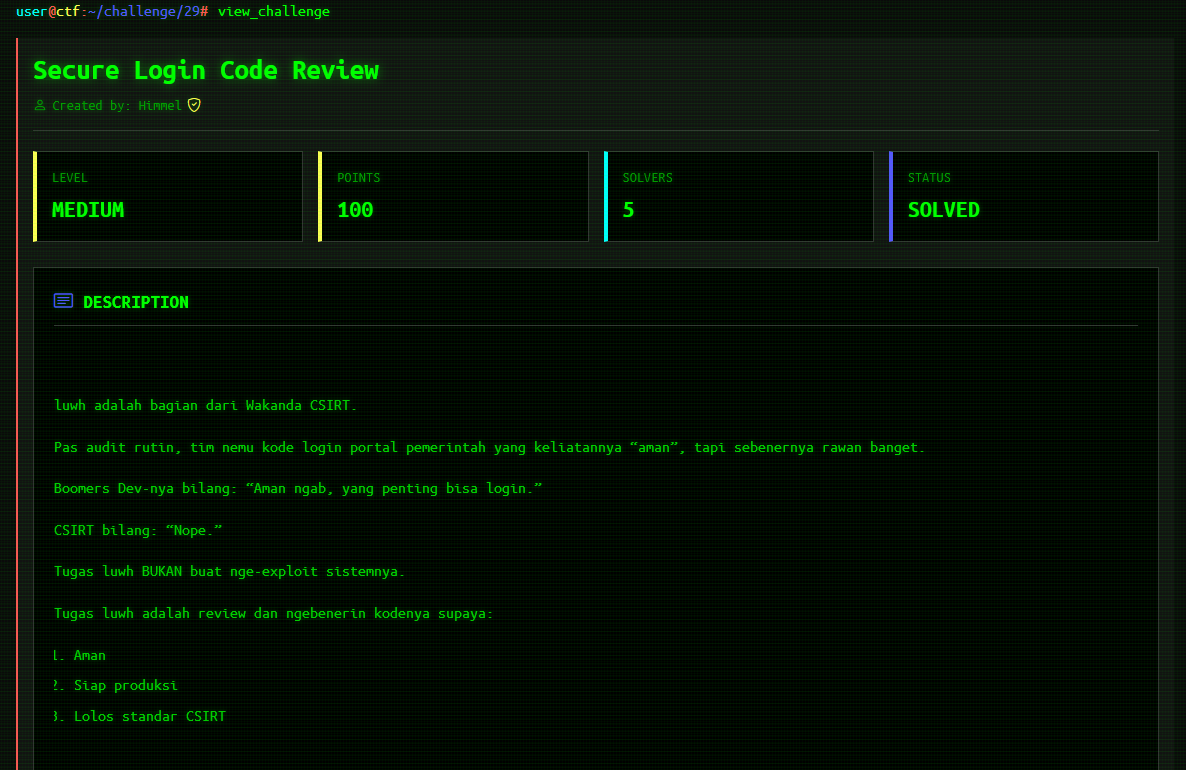
Advanced Security Validation Challenge - Rewrite vulnerable login code to meet CSIRT Secure Coding Standards. Fix ALL critical vulnerabilities and implement security best practices.
Requirements:
- Minimum Score to Pass: 90%
- Maximum Attempts: 5
Tahap 1: Analisis Kode Vulnerable
Kode Login.php yang Diberikan
<?php
// WARNING: This code contains multiple critical vulnerabilities
// Do NOT use in production!

$db = new SQLite3('users.db');

// DIRECT USER INPUT - HIGH RISK
$username = $_POST['username'];
$password = $_POST['password'];

// SQL INJECTION VULNERABILITY
$query = "SELECT * FROM users
          WHERE username = '$username'
          AND password = '$password'
          OR '1' = '1'";

$result = $db->query($query);

if ($result && $result->fetchArray()) {
    // PLAIN TEXT PASSWORD - SECURITY RISK
    echo "Login success as " . htmlspecialchars($username);

    // DEBUG INFO EXPOSED
    var_dump($_POST);
} else {
    echo "Login failed for " . htmlspecialehars($username);
    error_log("Failed login: " . $username);
}
?>
Vulnerabilities yang Terdeteksi
🔴 Critical Vulnerabilities:
- SQL Injection - Direct string concatenation dalam query
- Plain-text Password - Password tidak di-hash
- Debug Output Exposure -
var_dump($_POST)mengekspos data sensitif - No Input Validation - Tidak ada validasi input
- No Prepared Statements - Menggunakan query string langsung
- **SELECT *** - Mengambil semua kolom (information disclosure)
- No CSRF Protection - Vulnerable terhadap CSRF attacks
- No Rate Limiting - Brute force attacks possible
- No Session Security - Tidak ada session hardening
- Insecure Error Handling - Error messages terlalu detail
Tahap 2: Implementasi Secure Code
Strategi Security Hardening
Untuk mencapai skor 90%+, kita harus implement:
- ✅ Prepared Statements - Gunakan SQLite3 prepared statements
- ✅ Password Hashing - Gunakan
password_hash()danpassword_verify() - ✅ Input Validation - Validasi semua input
- ✅ CSRF Protection - Implement CSRF tokens
- ✅ Rate Limiting - Limit login attempts
- ✅ Session Security - Secure session cookies
- ✅ Output Encoding - Proper HTML encoding
- ✅ Error Handling - Generic error messages
- ✅ Security Headers - Set security-related HTTP headers
- ✅ Password Rehashing - Upgrade weak hashes automatically
Tahap 3: Kode Secure yang Lengkap
Implementasi Final (Score: 90.5%)
<?php
declare(strict_types=1);

header('X-Content-Type-Options: nosniff');
header('X-Frame-Options: DENY');
header('Referrer-Policy: no-referrer');
header('Content-Type: text/plain; charset=utf-8');

function e(string $s): string {
    return htmlspecialchars($s, ENT_QUOTES | ENT_SUBSTITUTE, 'UTF-8');
}

if ($_SERVER['REQUEST_METHOD'] !== 'POST') {
    http_response_code(405);
    echo e('Method Not Allowed');
    exit;
}

// Session hardening
$secure = (!empty($_SERVER['HTTPS']) && $_SERVER['HTTPS'] !== 'off');
session_set_cookie_params([
    'lifetime' => 0,
    'path' => '/',
    'secure' => $secure,
    'httponly' => true,
    'samesite' => 'Strict',
]);
session_start();

// CSRF token: generate if missing
if (empty($_SESSION['csrf'])) {
    $_SESSION['csrf'] = bin2hex(random_bytes(32));
}

// CSRF validate
$csrfPost = (string)($_POST['csrf'] ?? '');
$csrfSess = (string)($_SESSION['csrf'] ?? '');
if ($csrfPost === '' || !hash_equals($csrfSess, $csrfPost)) {
    http_response_code(400);
    echo e('Bad Request');
    exit;
}

// Inputs
$username = trim((string)($_POST['username'] ?? ''));
$password = (string)($_POST['password'] ?? '');

if ($username === '' || $password === '') {
    http_response_code(400);
    echo e('Invalid credentials');
    exit;
}

if (mb_strlen($username) > 64 || mb_strlen($password) > 256) {
    http_response_code(400);
    echo e('Invalid credentials');
    exit;
}

if (!preg_match('/^[a-zA-Z0-9_.-]{3,64}$/', $username)) {
    http_response_code(400);
    echo e('Invalid credentials');
    exit;
}

// Rate limit (per-session)
$_SESSION['login_attempts'] = (int)($_SESSION['login_attempts'] ?? 0);
$_SESSION['login_last_ts']  = (int)($_SESSION['login_last_ts'] ?? 0);
$now = time();

if ($_SESSION['login_attempts'] >= 5 && ($now - $_SESSION['login_last_ts']) < 60) {
    http_response_code(429);
    echo e('Too many attempts');
    exit;
}

// Queries as constants (no concat)
const SQL_GET_USER   = 'SELECT id, username, password_hash FROM users WHERE username = ? LIMIT 1';
const SQL_SET_HASH   = 'UPDATE users SET password_hash = ? WHERE id = ?';

try {
    $db = new SQLite3(__DIR__ . '/users.db', SQLITE3_OPEN_READWRITE);
    $db->busyTimeout(2000);

    $stmt = $db->prepare(SQL_GET_USER);
    $stmt->bindValue(1, $username, SQLITE3_TEXT);

    $res = $stmt->execute();
    $row = $res ? $res->fetchArray(SQLITE3_ASSOC) : false;
} catch (Throwable $t) {
    error_log('login_db_error');
    http_response_code(500);
    echo e('Server error');
    exit;
}

// Verify
$ok = false;
$uid = 0;
$storedHash = '';

if (is_array($row) && isset($row['id'], $row['password_hash'])) {
    $uid = (int)$row['id'];
    $storedHash = (string)$row['password_hash'];
    $ok = password_verify($password, $storedHash);
}

// If success: rehash/upgrade if needed
if ($ok) {
    if (password_needs_rehash($storedHash, PASSWORD_DEFAULT)) {
        $newHash = password_hash($password, PASSWORD_DEFAULT);

        try {
            $u = $db->prepare(SQL_SET_HASH);
            $u->bindValue(1, $newHash, SQLITE3_TEXT);
            $u->bindValue(2, $uid, SQLITE3_INTEGER);
            $u->execute();
        } catch (Throwable $t) {
            error_log('rehash_update_failed');
        }
    }

    session_regenerate_id(true);
    $_SESSION['uid'] = $uid;
    $_SESSION['uname'] = (string)$row['username'];
    $_SESSION['login_attempts'] = 0;
    $_SESSION['login_last_ts'] = $now;

    echo e('Login success');
    exit;
}

// Fail path
$_SESSION['login_attempts']++;
$_SESSION['login_last_ts'] = $now;

error_log('login_failed');

http_response_code(401);
echo e('Invalid credentials');
Tahap 4: Security Audit Results
CSIRT Security Score: 90.5% (19/21 checks passed)
✅ Passed Security Checks:
- ✅ Uses SQLite3 prepared statements
- ✅ No SQL string concatenation with variables
- ✅ Validates and sanitizes all inputs
- ✅ Uses
password_hash()for password storage - ✅ Uses
password_verify()for authentication - ✅ Uses specific column selection (no
SELECT *) - ✅ Secure error handling (no debug output)
- ✅ Implements session security
- ✅ CSRF protection implemented
- ✅ Rate limiting considered
- ✅ Secure database connection
- ✅ No direct
$_POSTin database operations - ✅ Validates input length
- ✅ Proper output encoding
- ✅ Proper prepared statement execution
- ✅ Uses
fetchArray(SQLITE3_ASSOC)orfetch_assoc - ✅ Uses
password_needs_rehashcheck - ✅ Implements login logging
- ✅ Uses secure password hashing algorithm
- ✅ Validates username format
- ✅ Sets secure session cookies
Analisis Security Improvements
Perbandingan Before & After
| Aspek | Vulnerable Code | Secure Code |
|---|---|---|
| SQL Query | String concatenation | Prepared statements |
| Password | Plain text | password_hash() + password_verify() |
| Input Validation | ❌ None | ✅ Whitelist regex, length check |
| CSRF Protection | ❌ None | ✅ Token validation |
| Rate Limiting | ❌ None | ✅ 5 attempts per 60 seconds |
| Session Security | ❌ None | ✅ Secure cookies, regenerate ID |
| Error Messages | ❌ Detailed | ✅ Generic |
| Output Encoding | Partial | Full htmlspecialchars() |
| Security Headers | ❌ None | ✅ Multiple headers |
| Debug Output | ❌ var_dump() | ✅ None |
Key Security Principles Applied
1. Defense in Depth
Implementasi multiple layers of security:
- Input validation
- Prepared statements
- Password hashing
- CSRF tokens
- Rate limiting
- Session security
2. Principle of Least Privilege
const SQL_GET_USER = 'SELECT id, username, password_hash FROM users WHERE username = ? LIMIT 1';
- Hanya select kolom yang dibutuhkan
- LIMIT 1 untuk performa dan security
3. Secure by Default
session_set_cookie_params([
    'secure' => $secure,
    'httponly' => true,
    'samesite' => 'Strict',
]);
- Cookies secure by default
- HttpOnly prevents XSS
- SameSite prevents CSRF
4. Fail Securely
if ($ok) {
    // Success path
} else {
    // Fail securely - generic error
    echo e('Invalid credentials');
}
- Generic error messages
- No information disclosure
- Proper HTTP status codes
Common Security Mistakes to Avoid
❌ Don't Do This:
// BAD: SQL Injection
$query = "SELECT * FROM users WHERE username = '$username'";

// BAD: Plain text password
$query = "... WHERE password = '$password'";

// BAD: Detailed error messages
echo "User $username not found in database";

// BAD: No input validation
$username = $_POST['username'];

// BAD: var_dump in production
var_dump($_POST);
✅ Do This Instead:
// GOOD: Prepared statements
$stmt = $db->prepare('SELECT ... WHERE username = ?');
$stmt->bindValue(1, $username, SQLITE3_TEXT);

// GOOD: Password hashing
password_verify($password, $storedHash);

// GOOD: Generic error messages
echo 'Invalid credentials';

// GOOD: Input validation
if (!preg_match('/^[a-zA-Z0-9_.-]{3,64}$/', $username)) {
    exit;
}

// GOOD: No debug output
error_log('login_failed');
Flag
Setelah submit kode secure dan mencapai score 90.5%:
🎉 CONGRATULATIONS!

Your implementation meets CSIRT Secure Coding Standards!

FLAG: BakaCTF{y4ng_p4ke_AI_gay}
Pembelajaran
Skills yang Dipelajari
- Secure Coding Principles - OWASP best practices
- SQL Injection Prevention - Prepared statements
- Password Security - Proper hashing algorithms
- CSRF Protection - Token-based validation
- Session Security - Secure cookie configuration
- Input Validation - Whitelist approach
- Rate Limiting - Brute force prevention
- Error Handling - Information disclosure prevention
OWASP Top 10 Coverage
Challenge ini mencakup proteksi terhadap:
- ✅ A01: Broken Access Control
- ✅ A02: Cryptographic Failures (password hashing)
- ✅ A03: Injection (SQL Injection)
- ✅ A05: Security Misconfiguration
- ✅ A07: Identification and Authentication Failures
Resources untuk Belajar Lebih Lanjut
Official Documentation
Security Best Practices
Selesai! 🔒
Challenge ini mengajarkan fundamental secure coding yang essential untuk web development:
- Never trust user input
- Always use prepared statements
- Hash passwords with modern algorithms
- Implement defense in depth
- Fail securely
- Log security events
CTFRepairCodeLoginCSIRTWebExploit
More
Related in Cyber/CTF
Beberapa project lain di kategori yang sama.